Showing posts with label 1st Semester Question Bank. Show all posts

Engineering Graphics–Set No . 1 Questions

1. A straight line AB of length 100 mm, initially tangential at A to a circle of 40 mm diameter, rolls without slipping on the circle, till the end B touches the circle. Show the paths of the ends A and B of the line and name the curves. [16]

2. The distance between the end projectors of a line AB is 50 mm. Point A is 15 mm above HP and 10 mm infront of VP. Point B is 40 mm above HP and 40 mm infront of VP. Find the true length of the line AB, the inclinations of the line AB with HP and VP. Locate HT and VT of the line by trapezoidal method. [16]

3. A hexagonal pyramid of base edge 20 mm and height 40 mm rests on one of the corners of the base in HP with its axis is inclined at 300 to HP and parallel to VP. A vertical section plane inclined at 300 to VP cuts the pyramid removing 15 mm length of the axis from apex. Draw the projections of the pyramid and find the true shape of the section. [16]

4. A vertical cylinder of base diameter 30 mm and axis 45 mm long is sectioned such that its front view appears as isosceles triangle of 30 mm and height 45 mm. Develop its surface. [16]

5. A vertical cone of 80 mm diameter and axis 100 mm long, is penetrated by hor- izontal cylinder of 60 mm diameter and 90 mm long such that, its axis is 5 mm behind the axis of the cone, at a height of 40 mm above its base. show the lines of instersection, when the axes of both solids are parallel to V.P. [16]

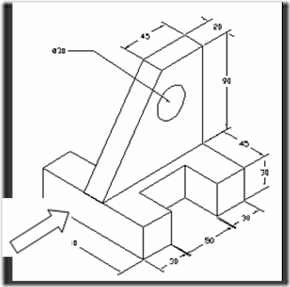
6. Draw the isometric view of the object whose orthographic projections are given in figure 6. All dimensions are in mm. [16]

clip_image001

Figure 6

7. Draw the following views of the dove tail stop given in figure 7. All dimensions are in mm.

(a) Front View

(b) Top View and

(c) Side View. [16]

clip_image002

Figure 7

8. Draw the perspective view of a rectangular plane of 40×30 mm which lies on the ground plane. One of the corners is touching the picture plane and an edge is inclined at 550 to picture plane. The station point is 30 mm in front of picture plane, 65 mm above the ground plane and lies in central plane which is at a distance of 30 mm to the right of the corner touching the picture plane. [16]

Engineering Chemistry 1–Question Bank–1st Edition

Anna University

ENGINEERING CHEMISTRY –I

QUESTION BANK

(COMMON TO FIRST YR – ALL BRANCHES)

UNIT 1 WATER TECHNOLOGY

PART - A

1. Differentiate hard water and soft water.

2. Define hardness.

3. What are the types of hardness? Differentiate them.

4. What are the tests for hardness?

5. Why hardness is expressed in CaCO3 equivalent?

6. What is EDTA? Write its structure?

7. What is the principle behind EDTA titration?

8. What is alkalinity? What are the possible reasons for alkalinity?

9. Give any four requirements for potable water?

10. What is boiler feed water? What are the basic requirements?

11. What are boiler problems? Name any 4 boiler problems?

12. Differentiate scales and sludge?

13. What is caustic embrittlement? How will you prevent it?

14. What is carry over? How will you prevent it?

15. What are the reasons for boiler corrosion?

16. What are boiler compounds?

17. How calgon conditioning is superior than other methods?

18. Why phosphate conditioning is preferred over carbonate conditioning?

19. What are the chemicals used for regeneration of ion exchange resins?

20. Give the name of membranes used in reverse osmosis process?

21. Give the advantages of RO process and ion exchange process?

22. What is break point chlorination? What is its significance?

23. What is disinfection? What are the different methods of disinfection?

24. Why a soft water need not be demineralised water but a DM is always soft water.

25. Give two examples for Cation exchange and anion exchange resins?

PART- B

1. How the alkalinity of a water sample is estimated volumetrically?

2. Explain the aim, principle, procedure, calculation involved in EDTA method?

3. Write a note of boiler problems?

4. What is ion exchange method? Explain the concept.

5. What is reverse osmosis? Bring out the methodology behind it.

6. How will you treat the water for drinking purpose?

7. What are boiler compounds? How are they used in internal water treatment?

UNIT-2 POLYMERS AND COMPOSITES

 PART-A

1. Define polymerization.

2. Define monomers and polymers.

3. Define degree of polymerization.

4. Give any four differences between addition and condensation polymerization.

5. What is copolymerization? What is co-polymer?

6. What are the three steps involved in free radical mechanism?

7. Define plastics. How can they be classified?

8. Mention any two advantages and disadvantages

9. Give four differences between engineering and commodity plastics.

10. Give any four differences between thermo and thermosetting plastics.

11. What are the uses of PVC and Teflon?

12. Write the synthesis of Nylon 6, 6 and polyurethane?

13. What is PET? Give its applications.

14. Define rubbers? What are the types of rubber?

15. What is vulcanization? What are the advantages of vulcanization?

16. What is Buna-S? How is it prepared?

17. Give the differences between raw and vulcanized rubber?

18. What are the defects of raw rubber? How can it

be rectified?

19. What are composites? What are the advantages of it?

20. What are the two phases of composites?

21. What are the different types of composites?

22. What is FRP? Mention its applications.

23. What is polymer matrix composite?

1. Write a note on addition polymerization. Differentiate it from condensation type.

2. Explain the steps involved in free radical mechanism.

3. Give the preparation, property, uses of PVC, Teflon and Polycarbonate.

4. Give the preparation, property, uses of Polyurethane, PET and nylon 6,6.

5. Differentiate thermo and thermoset plastics.

6. Differentiate engineering and commodity plastics.

7. Explain the mechanism, purpose and importance of vulcanization.

8. Differentiate raw and vulcanized rubber.

9. Explain the process of obtaining rubber from latex. What are the defects of raw rubber?

10. Write a note on any two synthetic rubbers.

11. Give a detailed note on different types of composites?

12. Explain about FRP and their applications.

UNIT 3 SURFACE CHEMISTRY

 PART-A

1. Define adsorption.

2. Differentiate adsorption and absorption.

3. What are adsorbent and adsorbate?

4. Differentiate physisorption and chemisorption.

5. Give any four characteristics of adsorption.

6. What is the effect of pressure, temperature on physisorption and chemisorption.

7. What is positive adsorption? And negative adsorption. Give examples.

8. Define adsorption isotherms.

9. What is Freundlich isotherm? What are the limitations?

10. What are the assumptions of Langmuir adsorption isotherm?

11. List out any four important applications of adsorption.

12. What is homogeneous catalyst? What is heterogeneous catalyst?

13. Why the solid catalyst should be used as a fine powder?

14. What are promoters and catalytic poison?

15. Give two examples for cation and anion exchange resins?

16. What is zeolite process?

17. What are the applications of activated charcoal?

18. What are GAC and PAC?

19. What are the factors affecting adsorption of gases on solid?

20. What are the factors affecting adsorption from solutions?

21. How is arsenic poisoning removed from the body?

1. Differentiate physisorption and chemisorption?

2. Explain the factors affecting adsorption of gases on solids.

3. Explain the factors affecting adsorption of solutes from solutions.

4. What are the five types of isotherms possible? Draw and explain the cases with eg.

5. Derive Langmuir adsorption isotherm.

6. Bring out the role of adsorption in heterogeneous catalyst?

7. Explain the principle of adsorption in ion- exchange process of water treatment?

8. What are the common applications of adsorption?

9. How can the pollution be reduced by activated charcoal.

UNIT 4 NON-CONVENTIONAL ENERGY SOURCES/ STORAGE DEVICES

PART-A

1. Differentiate nuclear fission and fusion.

2. Give any four characteristics of fission.

3. What is multiplication factor?

4. What is mass defect?

5. What is a nuclear chain reaction?

6. Define critical, sub critical and super critical mass.

7. What is nuclear energy?

8. Give any one fission reaction; mention the factors that impede the chain reaction.

9. Define nuclear reactor.

10. What are the components of a nuclear reactor?

11. What are moderators in nuclear reactor? What is its role?

12. What is a breeder reactor?

13. Mention any four applications of solar energy.

14. Define thermal conversion and photo conversion with eg.

15. What are the advantages of non- conventional energy sources than the conventional one?

16. Write short notes on wind energy.

17. Define fuel cell. Bring out its two applications.

18. What are the advantages and drawbacks of solar and wind energy.

19. What are fissile and fissionable nucleus? Give eg.

20. What are the reactions involved in oxygen – Hydrogen fuel cell?

21. What is a battery? What are the basic requirements of a battery?

22. Differentiate primary and secondary batteries?

23. What are the advantages of alkaline battery over dry battery?

24. Li battery is the battery of future – How?

25. What are the advantages of Li- S battery?

26. How NICAD battery is constructed?

27. Write the reactions taking place in an alkaline battery.

PART- B

1. What is a nuclear chain reaction? Explain the basic principles and characteristics of it.

2. Explain light water power plant with a neat sketch.

3. Explain the significance and working principles of breeder reactor with necessary equations and sketches.

4. Write an elaborate note on solar energy harnessing and applications.

5. Write a note on wind energy.

6. Explain the construction of O2-H2 fuel cells. State itsadvantages?

7. Explain the principle behind Lead acid accumulator.

8. What is the basic constructional idea behind NICAD battery?

9. Give the importance of Lithium battery. Explain the basic principles of it.

UNIT 5 ENGINEERING MATERIALS

PART-A

1. Define refractories. How can they be classified?

2. Give any four characteristics of refractories.

3. What is refractoriness? How is it measured?

4. What is segar cone test (or) PCE test?

5. What is RUL test?

6. Name the stages in manufacture of refractory?

7. What is porosity of a refractory? How can it

be modified?

8. What is thermal spalling? How will you control it?

9. What are the two types of dimension change?

10. Name two refractories which should not be kept in direct contact with fireclay refractory. Why?

11. What are abrasives?

12. What is abrasive powder?

13. What is moh’s scale?

14. How is carborundum prepared?

15. What is norbide? How can it be prepared?

16. Give the applications of garnet and emery.

17. What are the applications of abrasive?

18. How can we classify the abrasives? Give eg for each type.

19. Define lubricant. Classify them.

20. What is flash and fire point.

21. Define viscosity index.

22. Define cloud and pour point.

23. What are pour point depressants? Give eg.

24. What are greases? How can they be classified?

25. What are carbon nanotubes? What are the types?

26. What are nano materials?

27. What is nano chemistry?

28. Write down the synthetic methods to prepare carbon nanotubes.

29. Write any four applications of carbon nano tube.

30. Mention the various forms of SWNT.

PART-B

1. Classify the refractories. Explain one example for each type.

2. What are the properties of refractory? Explain any three of them.

3. Write notes on alumina, zirconia and magnesite bricks.

4. Write a note on synthetic abrasives.

5. What is your understanding about natural abrasives?

6. How will you explain the mechanism behind the lubrication?

7. Explain any four properties of lubricants?

8. How can you classify lubricants? Explain.

9. Write notes on solid lubricants.

10. Bring out the important applications of CNT.

11. Write a note on structure and synthesis of CNT.

Engineering Graphics–Question Bank

Anna University

ENGINEERING GRAPHICS - QUESTION BANK

UNIT – I (PLANE CURVES & FREEHAND SKETCHING

a) ELLIPSE, PARABOLA & HYPERBOLA

1. Draw the locus of a point P moving so that the ratio of its distance from a fixed point F to its distance from a fixed straight line DD’ is ¾ . Also draw tangent and normal to the curve from any point on it.

2. Construct an ellipse given the distance of the focus from the directrix as 60 mm and eccentricity as 2/3. Also draw tangent and normal to the curve at a point on it 20 mm above the major axis.

3. Construct a parabola given the distance of the focus from the directrix as 50 mm. Also draw tangent and normal to the curve from any point on it.

4. Draw the locus of a point P moving so that the ratio of its distance from a fixed point F to its distance from a fixed straight line DD’ is 1. Also draw tangent and normal to the curve from any point on it.

5. Draw a hyperbola when the distance between the focus and directrix is 40 mm and the eccentricity is 4/3. Draw a tangent and normal at any point on the hyperbola.

b) CYCLOIDS & INVOLUTES

6. Draw the involute of a square of side 30 mm. Also draw tangent and normal to the curve from any point on it.

7. A coir is unwound from a drum of 30mm diameter. Draw the locus of the free end of the coir for unwinding through an angle of 360°. Draw also a tangent and normal at any point on the curve.

8. A circle of 50 mm diameter rolls along a straight line without slipping. Draw the curve traced by a point P on the circumference for one complete revolution. Draw a tangent and normal on it 40 mm from the base line.

9. Draw an epicycloids generated by a rolling circle of diameter 40 mm and the diameter of the directing circle is 140 mm. Also draw tangent and normal to the curve from any point on it.

10. Draw a hypocycloid generated by a rolling circle of diameter 50 mm and the diameter of the directing circle is 240 mm. Also draw tangent and normal to the curve from any point on it.

c) FREEHAND SKETCHING (ORTHOGRAPHIC PROJECTIONS FROM PICTORIAL VIEWS)

11. Draw the Orthographic views (Front, Top & Side views) of the given objects shown below.

a)

clip_image006

b)

clip_image008 

c)

clip_image010

d)

clip_image015

e)

clip_image018

f)

clip_image020

g)

clip_image022

UNIT – II (PROJECTION OF POINTS, LINES & PLANE SURFACES)

a) POINTS

1. Mark the projections of the following points on a common reference line: P, 35 mm behind the VP and 20 mm below the HP.Q, 40 mm in front of VP and 30 mm above the HP. R, 50 mm behind the VP and 15 mm above the HP. S, 40 mm below the HP and in the VP.

2. A point C is on HP and 15 mm behind VP. Another point D is also on HP and 40 mm in front of VP. The distance between their projectors is 45 mm. Join their front views and determine inclination of this line with XY line.

3. A point P is on HP and 20 mm in front of VP. Another point Q is also on HP and behind VP. The distance between their end projectors is 60 mm. Draw its projections if the line joining P & Q makes an angle of 60º with the reference line. Also find the positions of point P and Q.

b) LINES

4. A line PQ, 50 mm long is perpendicular to HP and 15 mm in front of VP. The end P nearer to HP 20 mm above it. Draw the projections of the line.

5. A line PQ, 60 mm long has one end P, 20 mm above the HP and 35 mm in front of VP. The line is parallel to HP. The front view has a length of 50 mm. Find its true inclinations with VP.

6. A line NS, 80 mm long has its end N,10 mm above the HP and 15 mm in front of VP. The other end S is 65 mm above the HP and 50 mm in front of VP. Draw the projections of the line and find its true Inclination with HP and VP.

7. The end P of a line PQ is 30 mm above HP and 35 mm in front of VP. The line is inclined at 35° to HP. Its top view is 70 mm long inclined at 40° to XY. Draw the projections of straight line. Find the true length and inclination of the line with VP.

8. A line MN has its end M, 15 mm in front of VP and 20 mm above the HP. The other end N is 55 mm in front of VP. The front view has a length of 80 mm. The distance between end projectors is 65 mm. Draw the projections of line. Find its true length and true inclinations by trapezoidal method.

9. The mid point of a line AB, 80 mm long, is 30 mm above HP and 45 mm in front of VP. The line is inclined at 30º to HP and 50º to VP. Draw the projections.

10. A straight line ST has its end S, 10 mm in front of VP and nearer to it. The mid point ‘m’ of the line is 50 mm in front of VP and 40 mm above HP. The front and top views measure 90 mm and 120 mm respectively. Draw the projections of the line. Also, find the true inclinations with VP and the HP.

11. A line MN has its end M, 10 mm in front of VP and 15 mm above HP. The other end N is 50 mm in front of VP. The front view has a length of 70 mm. The distance between the end projectors is 60 mm. Draw the projections of the line. Find its true length, true inclinations and traces by trapezoidal method.

c) PLANE SURFACES

12. A regular hexagonal lamina of side 30 mm rests on one of its edges on HP. The lamina makes 60°with HP and the edge on which it is resting makes an angle of 60° with VP. Draw its projections.

13. A circular plate of diameter 70 mm has the end P of the diameter PQ in the HP and the plate is inclined at 40° to HP. Draw its projections when the diameter PQ appears to be inclined at 45° to VP in the top view.

14. A hexagonal plate of side 20 mm rests on the HP on one of its sides inclined at 45° to VP. The surface of the plate makes an angle of 30° with the HP. Draw the front view and top view of the plate.

UNIT – III (PROJECTION OF SOLIDS)

1. A cube of side 40 mm rests on the HP on one of its ends with a vertical face inclined at

40°to VP. Draw its projections (top view, front view and side view).

2. A pentagonal prism of base side 30 mm and axis length 55mm is lying on the ground on one of its rectangular faces. Draw its top view, front and left side view when its axis is perpendicular to VP and the end nearer to the VP is 15 mm away from it.

3 A hexagonal prism of base side 30 mm and axis length 60 mm rests on the HP on one of its base edges with its axis inclined at 60° to HP and parallel to the VP. Draw its top and front views.

4. A cylinder of diameter 30 mm and axis length 50 mm is resting on the HP on a point so that its axis is inclined at 45° to HP and parallel to VP. Draw its top and front views.

5. A hexagonal prism, side of base 20mm and axis 60mm long lies on one of its longer edges on HP and its axis is parallel to both HP and VP. Draw its projections.

6. Draw the projection of a cone of diameter 40mm and height 70mm lying on the ground on one of its base points with a generator perpendicular to HP.

7. A cone of base diameter 50mm and axis length 65mm is resting on H.P on a point on the circumference of the base with its axis inclined at 400 to V.P and parallel to H.P. Draw its Projections.

8. A square prism of base side 35mm and axis length 60mm lies on the HP on one of its longer edges with its faces equally inclined to the HP. Draw its projections when its axis is inclined at 300 to the VP.

9. A square pyramid of base side 35mm and axis length 65mm is resting on HP on one of its triangular faces with its axis parallel to VP. Draw its projections.

10. A right pentagonal pyramid of side 20 mm and altitude 50 mm rests on one of its edges of the base in the HP. The base being tilted up such that the apex is 30 mm above HP. Draw the projection of the pyramid when the edge on which it is resting is perpendicular to VP.

11. A hexagonal pyramid of side 25mm, axis 75 mm long lies with one of its triangular faces on the HP and its axis parallel to VP. Draw its projections.

UNIT – IV (SECTION OF SOLIDS AND DEVELOPMENT OF SURFACES))

SECTION OF SOLIDS

1. A cube of side 30 mm rests on the HP on its end with the vertical faces equally inclined to the VP. It is cut by a plane perpendicular to the VP and inclined at 30° to HP meeting the axis at 25 mm above the base. Draw its front view, sectional top view and true shape of the section.

2. A pentagonal prism of base side 40mm and height 85mm rests on the H.P such that two of its base edges are equally inclined to VP. It is cut by a plane perpendicular to the V.P and inclined 450 to the H.P. The cutting plane meets the axis at 30mm from the top. Draw the front view, sectional top view and true shape of the section.

3. A hexagonal prism of side of base 20 mm and length 60 mm rests on HP with its axis being vertical and one edge of its base inclined at 15° to VP. The solid is cut by a plane perpendicular to VP and inclined at 40° to HP and bisecting the axis of the prism. Draw the projections of the prism and true shape of thesection.

4. A cylinder of diameter 50mm and height 60mm rests on its base on H.P. It is cut by a plane perpendicular to V.P. and inclined at 450 to H.P. The cutting plane meets the axis at a distance of 15mm from the top. Draw the sectional plan and true shape of the section.

5. A right circular cone of base diameter 50mm and axis length 60mm rests on its base on the H.P. It is cut by a plane perpendicular to the H.P and inclined at 600 to the VP. The shortest distance between the cutting plane and the top view of the axis is 8mm. Draw the top view, sectional front view and the true shape of the section.

6. A pentagonal pyramid of base side 20mm and altitude 55mm rests on its base on HP with one base edge being perpendicular to VP. It is cut by plane inclined at 500 to base. The cutting plane meets the axis at 15mm above the base. Draw the front view, sectional top view and true shape of the section

7. A hexagonal pyramid of base side 25mm and axis 55 mm rests on its base on the HP with two base edges perpendicular to VP. It is cut by a plane perpendicular to VP and inclined at 30° to HP, meeting the axis at 20mm from the vertex. Draw its front view, sectional top view and true shape of the section.

8. A square pyramid of base side 25mm and altitude 40mm rests on the HP on its base with the base edges equally inclined to the VP. It is cut by a plane perpendicular to the VP and inclined at 30° to the HP meeting the axis at 21mm above the HP .Draw the sectional top view and the true shape of the section.

9. A cone of base diameter 50mm and altitude 60mm rests on its base on the HP. It is cut by a plane perpendicular to the VP and inclined at 400 to the HP. The cutting plane meets the axis at 30mm from the vertex .Draw the sectional top view.

10. A cone of base diameter 50mm and altitude 60mm rests on its base on the HP . It is cut by a plane perpendicular to the VP and parallel to one of the extreme generators , 10mm away from it .Draw the sectional top view and the true shape of the section

DEVELOPMENT OF SURFACES

1. A pentagonal prism of base side 30 mm and axis height 75 mm is resting on its base on HP with two of its lateral surfaces parallel to VP. It is cut by plane perpendicular to VP and inclined at 45º to HP, bisecting the axis. Draw the development of lateral surfaces of the lower portion of the prism.

2. A hexagonal prism of base side 30 mm and axis height 70 mm is resting on its base on HP with one of its faces parallel to VP. It is cut by plane perpendicular to VP and inclined at 35º to HP, meeting the axis at a distance of 40 mm from the base. Draw the development of lateral surfaces of the lower portion of the prism

3. A pentagonal prism of base side 30 mm and height 60 mm is cut by a plane perpendicular to VP and 50º to HP and passing through the axis at a height of 35 mm above the base. Draw the development of the lower portion of the solid.

4. A hexagonal prism of side of base is 25 mm and height 55mm rests with its base on HP and one of its rectangular faces is parallel to VP. A circular hole of 40 mm diameter is drilled through the prism such that the axis of the hole bisects the axis of the prism at right angles and is perpendicular to VP. Draw the development of the lateral surface of the prism with the hole.

5. A cylinder of diameter 45 mm and height 70 mm is resting vertically on one of its ends on the HP. It is cut by a plane perpendicular to VP and inclined at 45º to HP. The plane meets the axis at a point 35 mm above the base. Draw the development of the lateral surface of the lower portion of the truncated cylinder.

6. A vertical chimney of 60 m diameter joins a roof sloping at an angle of 35º with the horizontal. The shortest portion over the roof is 25 m. Determine the shape of the sheet metal from which the chimney can be fabricated. Take a scale of 1:20.

7. A right circular cone of base diameter 50 mm and height 75 mm is resting on its base on the ground. It is cut by a plane perpendicular to VP and inclined at 30º to HP. The cutting plane bisects the axis of the cone. Draw the development of the lateral surface of the truncated cone.

8. A cone of base diameter 50 mm and height 75 mm rests vertically on its base on the ground. A string is wound around the curved surface of the cone starting from the left extreme point on the base and ending at the same point. Find the shortest length of the string required. Also trace the path of the string in front and top views.

9. A hexagonal pyramid of base side 30 mm and height 65 mm rests on its base on the ground with a base edge parallel to VP. It is cut by a plane perpendicular to VP and inclined at 55º to HP and meets the axis at a height of 30 mm from the base. Draw the lateral surface development.

10. A square pyramid of base side 25 mm and altitude 50 mm rests on its base on the HP with two side of the base parallel to VP. It is cut by a plane bisecting the axis and inclined at 30º to the base. Draw the development of the lower part of the pyramid.

11. A pentagonal pyramid of base side 30 mm and height 70 mm is resting vertically on its base on the ground with one of its base edge parallel to VP. It is cut by a plane perpendicular to VP and parallel to HP at a distance of 35 mm above the base. Draw the development of the lateral surfaces of the frustum of pyramid. Also show the sectional plan view.

12. A pentagonal prism of base side 25mm and height 60mm stands on one of its ends on the HP with a rectangular face parallel to the VP.A hole of diameter 30mm is drilled centrally through the prism in such a way that the axis of the hole bisects the axis of the prism at right angles. The axis of the hole is perpendicular to the VP. Draw the development of the lateral surfaces of the prism.

13. A circular hole of diameter 30mm is drilled through a vertical cylinder of diameter 50mm and height 65mm .The axis of the hole is perpendicular to the VP and meets the axis of the cylinder at right angles at a height of 30mm above the base. Draw the development of the lateral surface of the cylinder.

UNIT – V ISOMERTIC AND PERSPECTIVE PROJECTION

ISOMERTIC PROJECTION

1. A cylinder of height 65 mm and diameter 40 mm is resting on its base on the HP. It is cut by a plane perpendicular to VP and inclined at 30º to the HP. The plane passes through a point on the axis located at 25 mm from the top. Draw the isometric projection of the cut cylinder.

2. A frustum of a square pyramid of bottom edge 50 mm, top edge 25 mm and height 50 mm. Draw the isometric projection of the frustum.

3. A hexagonal pyramid of base 25 mm and height 60 mm stands with its base on the HP with an edge of base parallel to VP. A horizontal plane cuts the pyramid and passes through a point on the axis at a distance of 30 mm from the apex. Draw the isometric projection of the frustum of the pyramid.

4. A pentagonal pyramid of base side 30 mm and height 65 mm stands with its base on HP with a side of base perpendicular to VP. It is cut by a plane inclined at 30º to HP and perpendicular to VP and passes through a point at a distance of 30 mm from the apex. Draw the isometric view of the bottom portion of the pyramid.

5. Draw the isometric projection of a hexagonal prism of base side 25 mm and height 50 mm when it rests on one of its ends on HP with two its base sides parallel to VP.

6. A cone of 50 mm diameter and height 70 mm stands on HP with its base. It is cut by a cutting plane perpendicular to VP and inclined at 30º to HP, cutting the axis of the cone at a height of 40 mm from the base. Draw the isometric view of the remaining part of the cone.

PERSPECTIVE PROJECTION

1. A cube of side 40mm is resting on the ground on one of its faces, with a vertical face in PP and the rest behind it. The central plane is located 50mm to the left of the axis of the cube. This station point is 40mm in front of PP and 60mm above GP. Draw the perspective view of the solid.

2. A square pyramid of side of base 50mm and altitude 70mm stands on the ground vertically with an edge of base parallel to and 20mm behind PP. The station point is 40mm in front of PP and 70mm above the ground. The central plane is located 45mm to the left of the axis of the solid. Draw the perspective view of the solid.

3. A Pentagonal pyramid of 30mm base side and axis height 40mm is standing on its base on the ground Plane with a base side parallel to and 25mm behind PP. The central plane is 35mm to the left of the apex and the station point is 40mm in front of PP and 20mm above the GP. Draw the perspective view of the solid.

4. A cylinder of diameter 40mm and height 65mm rests with its base on the GP such that the axis is 25mm behind the PP. The station point is 30mm in front of the PP and 110mm above the GP and lies in a central plane which is 65mm to the right of the axes of the solids. Draw the perspective view of the cylinder.

5. Draw the perspective projection of a square prism of base side 40 mm and height 50 mm. One of the vertical lateral faces is parallel to PP and 30 mm behind it. The station point is 80 mm from the PP and 80 mm above the ground and 60 mm to the right of the axis of the prism. (Use visual ray method.

Engineering Chemistry 1–Question Bank (2011 Edition)

Anna University

Sem/Year: I / I

Sub. Name: Engg.Chemistry-I

UNIT I WATER TREATMENT PROCESS:

PART – A ( 2 Marks)

1. Define hardness of water.

2. Distinguish between carbonate hardness and noncarbonate hardness.

3. Draw the structure of EDTA. What happens when EDTA is added to hard water?

4. Define alkalinity.

5. Why is water softened before using in boiler?

6. What is meant by priming and foaming? How can they be prevented?

7. What is meant by caustic embrittlement? How is it prevented?

8. Indicate the reasons for boiler corrosion.

9. What is the role of phosphates in the internal treatment of water?

10. What is calgon conditioning? How is it functioning in water treatment?

11. Mention requisites of potable water.

12. Write briefly on disinfection of water by UV treatment.

13. Write the principle involved in the desalination of water by reverse osmosis.

14. Define the term break-point chlorination.

15. Define desalination.

16. What is Sodium zeolite? What is its use?

PART – B ( 16 Marks)

1. (i) What is the principle of EDTA method? Describe the estimation of

Hardness of water by EDTA method. (8)

(ii) What is the various methods by which disinfection of domestic water is carried out? Explain. (8)

2. (i) Describe briefly the different steps in the purification of water for drinking

Purposes. (8)

(ii) What is desalination? Name the different methods of desalination. Explain any one in detail. (8)

3. (i) Discuss briefly about the problems caused due to the usage of hard water in boilers. (8)

(ii) What are Zeolites? How do they function in removing the hardness? (8)

4. (i) How is internal treatment of boiler water carried out? (8)

(ii) Describe the principle and method involved in the determination of different types and amount of alkalinity of water (8)

UNIT II SURFACE CHEMISTRY

PART – A ( 2 Marks)

1. How does chemisorption differ from physisorption?

2. How will you increase the activity of adsorbent?

3. Define adsorption? What is an adsorption isotherm?

4. What is Freundlich’s adsorption isotherm?

5. What are promoters?

6. What is catalytic poisoning?

7. What is the effect of temperature and pressure on the adsorption of hydrogen gas on charcoal?

8. Define ion-exchange adsorption

9. What is langmuir adsorption isotherm? How it is mathematically represented?

10. What is the demerit of langmuir adsorption isotherm?

PART – B ( 16 Marks)

1. (i) Distinguish between physical adsorption and chemisorption. [6] (ii)Derive an expression for Langmuir unimolecular adsorption isotherm. What are its limitations? [10]

2 (i) Explain adsorption theory (or) contact theory with examples. [6] (ii) Explain the classification & functions of ion-exchangers.[10]

3 (i) Define the term adsorption and list its application [4]

(ii) Explain the role of adsorption in demineralization of water.[8] (iii) Give any three factors on which adsorption depends [4]

4 (i) Derive Freundlich’s adsorption isotherm. Give the conditions in which It fails. [6]

(ii) Explain the role of adsorption in catalytic reactions [10]

5 (i) Discuss the factors which influence adsorption of gas on a solid. [8] (ii) Define adsorption isotherm. Explain the various types of adsorption Isotherm. [8]

6 (i) Explain the role of adsorbents in pollution abatement. [12]

(ii) Define the terms adsorbent and adsorbate giving suitable examples.[4]

UNIT III ELECTROCHEMISTRY

PART – A ( 2 Marks)

1. What is a cell? Mention its types.

2. Define the terms (i) single electrode potential (ii) Electrochemical cells.

3. Define Helmholtz electrical double layer.

4. Write Nernst equation.

5. Define a reference electrode. Give one example.

6. What is electromotive series? What is its significance?

7. What is electrode concentration cell? Give one example.

8. Find the potential of the cell in which the following reactions takes place at 250 C.

Zn (s) + Cu2+ (0.02M) → Cu(s) + Zn2+ (0.4M)

9. What is electro chemical cell?

10. Why can glass electrode not be used for a solution of high alkalinity?

11. What are reversible & irreversible cells?

12. What are the advantages of conductometric titrations?

PART B [ 16 marks]

1. (i) Derive Nernst equation. Give its significances. (8)

(ii) What are reference electrodes? Describe any two reference electrodes with neat diagram and mention their uses. (8)

2. (i) Describe a glass electrode. How can it be used for determining the pH Of a solution? (8)

(ii) How is Emf of a galvanic cell measured by poggendroff’s compensation method? (5)

(iii) Consider the cell reaction,

Zn(s) +Fe2+ (0.005 M) –> Zn2+ (0.01 M) + Fe(s)

Given that the standard emf of the cell at 298 K is 0.323 V. Construct the cell and Calculate the emf of the cell. (3)

3. (i) What are Reference Electrode? Explain the types with neat diagrams and mention their uses (8)

ii) Describe the construction and working of calomel electrode & hydrogen electrode (4+4)

4. (i) What is the principle underlying conductometric titration? Explain acid-base titrations with neat graph. (8)

(ii)Describe a quinhydrone electrode how it can be used for the determination of pH of the solution? (8)

5. (i) What is the principle underlying Potentiometric titration? Explain Redox titrations with neat graph. (8)

(ii)What is electrochemical series .Give its applications (8)

UNIT IV ENERGY SOURCES AND ENERGY STORING DEVICES:

PART A ( 2 Marks)

1. Define nuclear fission.

2. What is nuclear chain reaction/

3. What is a nuclear reactor?

4. Mention any two differences of a nuclear reaction and a chemical reaction?

5. What is breeder reactor?

6. What is solar cell?

7. What are the applications of hydrogen-oxygen fuel cell?

8. What is wind energy? How is it obtained?

9. What is fissile and fertile nucleides?

10. What is super critical mass and sub critical mass?

11. What is nuclear energy?

12. What is a battery? How does it differ from a cell?

13. What are the advantages of alkaline battery over dry cell?

14. How is NICAD battery constructed?

PART – B ( 16 Marks)

1. (i) What is a nuclear reactor? Describe the components of a light water nuclear power Plant with a suitable block diagram. (10)

(ii) Explain the mechanism and characteristics of a nuclear fission reaction with suitable Example. (6)

2. i)What is reversible battery? Describe the construction and working of lead acid storage battery with reacting occurring during charging and discharging. (8)

(ii) How is NICAD battery constructed? Explain with cell reactions. Give its uses. (8)

3 i) Write a brief note on Lithium battery. (8)

ii) What are Fuel cells? Explain the construction and working of H2-O2 fuel cell.(8)

4. i) Define Photo galvanic cell. Explain its working with diagram. Give its applications. (10)

ii) Write note on wind energy. (6)

UNIT V ANALYTICAL TECHNIQUES AND CHEMOMETRICS:

PART – A ( 2 Marks)

1. State Beer –Lambert’s law. Give its limitations.

2. Name the components of colorimeter.

3. What is flame photometry?

4. How are alkali and alkaline –earth metals detected in flame photometry? Give examples.

5. What are the sources of UV light in UV-Visible spectrophotometer?

6. Define the term Bathochromic shift.

7. What is finger print region? Mention its important uses.

8. Write any two disadvantages of AAS.

9. Compare atomic absorption spectroscopy and flame emission spectroscopy

10. How are IR spectral range subdivided?

11. What are the limitations of flame photometry?

PART – B ( 16 Marks)

1. (i) Derive Beer-Lambert’s law. Give its limitations. (8)

(ii)What is Colorimetry? With a block diagram explain how it is used to estimate iron (8)

2. (i) Explain briefly the principle and instrumentation of flame photometry. How do you estimate sodium using flame photometry? (8)

(ii)Explain the various components and working of UV-Visible Spectrophotometer. (8)

3. (i)What is IR spectroscopy?. Explain the various components and working of IR spectrophotometer. (8)

ii) With neat energy level diagram explain various transitions involved in UV Spectra. (8)

4.(i) Explain how different fundamental modes for different types of compounds Are estimated in IR spectra. (8)

(ii) Discuss the principle of atomic absorption spectroscopy. Give the block diagram of AAS.(8)

Anna University–Engineering Chemistry 1–Important Two Marks

Engineering Chemistry 1 – Important Two Marks

1. What are refractories? How are they classified?

2. Define refractoriness.

3. What is meant by refractoriness under load?

4. What is meant by refractoriness of a refractory?

5. Why is silica bricks expand on heating?

6. Define porosity of a refractory.

7. What is meant by dimensional stability? Mention their types.

8. What is meant by thermal spalling? Mention two causes of thermal spalling.

9. Pyrometric cone equivalents of bricks A, B and C are 28, 32 and 36

respectively. Arrange these in order of their increasing refractoriness.

10. What is an abrasive?

il. What are soft abrasives?

12. Mention some important applications of abrasives.

13. What is abrasive power?

14. What is diamond? Mention its types.

15. How is carborundum prepared?

16. What is Garnet? Give its uses?

17. What is Moh’s scale? Name the hardest substance known.

18. How is silicon carbide synthesized?

19. Define lubricant.

20. Why is lubricant needed?

21. Give two examples each for liquid, semi solid and solid lubricants.

22. Why are antioxidants added o hydrocarbon oils?

23. What is meat by the term oiliness of lubricating oil? How it can be

improved?

24. What are viscosity index improvers? Give examples.

25. What are blended oils?

26. What are pour point depressants? Give examples.

27. What are solid lubricants? Mentiontheir applications.

28. Under what conditions extreme pressure lubricant is used.

29. What should be flash point of a good lubricant?

30. What is significance of determining the pour point of a lubricant?

31. Why does graphite act as lubricant?

32. What are nanomaterialS?

33. What are carbon nanotubes?

34. What are fullerenes?

35. Give some examples for catalytic reaction, carried out by using CNTs.

36. Mention the important forms of SWNTs.

37. How is CNT produced in carbon arc method?

•38. What are greases? How are they classified?

39. Mention some important applications of CNTs.

Anna University - Engineering Physics - 1 - Question Bank - 2011 Edition


UNIT-1 - CONDUCTING MATERIALS 
Part – A 
  1. Define mobility give its unit. 
  2. Define Drift velocity. 
  3. What are the drawbacks of classical free electron theory. 
  4. Define Mean free path. 
  5. Define Collision Time. 
  6. Define Electrical Conductivity. 
  7. Define Thermal Conductivity. 
  8. State Wiedemann-Franz law. 
  9. Define Lorentz number. 
  10. Define relaxation time of an electron. 
  11. What is Planck’s Hypothesis. 
  12. State Planck’s radiation – law. 
  13. Define Compton-effect. 
  14. Write Plack’s radiation formula. 
  15. Write down Schroedinger time independent and time dependent wave equation with symbol. 
  16. Give the physical significance of wave function. 
  17. What are the eigen value and eigen function ? 
  18. Write Fermi-Dirac distribution formula. 
  19. Define Fermi level and Fermi Energy with its importance. 
  20. How does Fermi function varies with temperature 
  21. What is work function. 
  22. what are bound and free electron. 
  23. For Copper the relaxation time is 10-14 seconds. The free electron density is 
  24. 2 × 1028/ m3. Calculate its electrical conductivity. 
  25. What is the probability of an electron bring thermally promoted to the Conduction band in silicon (Ec= 1.07 eV) at 25°C ? 
  26. Give the expression for change in wavelength of a scattered X-ray Photon. 
Part-B 
  1. Derive the electrical conductivity of a metal based on classical free electron theory. 
  2. Derive the thermal conductivity of a metal based on classical free electron theory. 
  3. State and Prove Wiedemann-Frantz law. 
  4. What is Compton effect ? Give the theory of Compton effect and Show that the Compton shift Δλ = h . (1 – cosθ)/m0c. 
  5. Explain the application of Schrodinger wave equation to a one Dimensional Potential well. 
  6. Derive Time independent Schroedinger wave equation and hence deduce the time dependent Schroedinger equation. 
  7. Describe the energy band theory of solids with the help of neat band diagram. Distinguish between metals insulator and semiconductor on the basis of band theory. 
  8. Derive the expression for Planck’s theory of Black body radiation. 
Unit- II - SEMI CONDUCTORS MATERIALS 
Part – A 
  1. What are compound semi conductors ? Give examples. 
  2. Why do the conductivity of a semi conductor increase with temperature ? 
  3. What is an intrinsic-semi conductor ? 
  4. Why do masses of electron and hole vary in semi-conductor ? 
  5. What is an extrinsic-semi conductor? 
  6. Define Fermi level in the case of semi conductors. Mention its position in intrinsic and extrinsic semiconductors at 0˚K. 
  7. Calculate the wavelength of radiation emitted by LED made up of a semi-Conducting material with Band gap energy (Eg) 2.8 eV. 
  8. What is an N-type semi-conductor? Give example. 
  9. What is an P-type semi-conductor? Give example. 
  10. How does the Fermi-level change with temperature in extrinsic semi conductors ? 
  11. What is meant by band gap in solids ? Mention its units. 
  12. What is Hall effect. 
Part-B 
  1. Obtain and expression for the carrier concentration in an intrinsic semi conductor. Calculate the intrinsic concentration of charge carriers at 300˚K, given me= 0.12mo, 
  2. Discuss electrical conductivity of intrinsic semi-conductor and hence derive an expression for the band gap energy. 
  3. Derive an expression for carrier concentration in an N-type semi conductor (Density of electrons in the conduction band). 
  4. Derive an expression for the density of holes in the valence band of an P-type semi conductor. 
  5. Discuss the variation of Fermi-level with temperature in N-type and P-type semi conductors. 
  6. Discuss the variation of carrier concentration with temperature for N-type and P-type semiconductors. 
  7. Explain the determination of Hall co-efficient, carrier concentration and mobility of charge carriers of a semi conductor. 
UNIT-3 MAGNETIC AND SUPERCONDUCTING MATERIALS:M 
PART-A 
  1. What is magnetic material? 
  2. Define magnetic Induction give its unit 
  3. Define magnetic field Intensity give its unit 
  4. Define free space permeability 
  5. Define Magnetic permeability 
  6. Define relative permeability 
  7. Define Intensity of magnetization 
  8. What is magnetic susceptibility 
  9. .What is the relationship between relative permeability and magnetic susceptibility? 
  10. State any four properties of Dia magnetic substance 
  11. State any four properties of Para magnetic substance 
  12. State any four properties of Ferro magnetic substance 
  13. Define domain 
  14. Distinguish between Ferro magnetic and antiferro magnetic 
  15. What is Curie temperature? 
  16. Define Bohr magnetron 
  17. Define Magnetic moment 
  18. Define Hysteresis 
  19. Distinguish between hard magnetic materials and soft magnetic material 
  20. Define GMR effect 
  21. Write a short note on bubble memories 
  22. Distinguish between RAM and ROM 
  23. Define Transition temperature 
  24. Define Super conductivity 
  25. Distinguish between Type-I and Type-II superconductor 
  26. What is Meissner Effect? 
  27. Define Isotope effect 
  28. What is high temperature superconductor? give example 
  29. What is SQUIDS? 
  30. What is magnetic levitation? 
  31. How are different magnetic materials classified? 
  32. What are the different sources of permanent magnetic moment? 
  33. What is curie –Weiss Law? 
  34. Give the significance of Curie Weiss law 
  35. What is Heisenberg theory of ferromagnetism? 
  36. What is meant by Hysteresis loss? 
  37. Define Energy product of magnetic material. 
  38. What are the applications of ferrites? 
  39. Why are ferrites advantageous for use as transformer cores? 
  40. Explain the importance of the magnetic materials 
  41. What are the five basic parts of a digital magnetic tape system? 
  42. How is earth garnets used for data storage? 
Part B 

Magnetic materials:

  • What are diamagnetic and paramagnetic susceptibilities of material? Discuss the temperature variation of their susceptibility. 
  • Discuss Langevin theory of a paramagnetic gas and obtain an expression for the paramagnetic susceptibility of the gas. What are the main drawbacks of the theory? 
  • Derive an expression for the magnetic moment M of a paramagnetic solid on the basis of quantum theory. 
  • What is Ferro magnetism? Explain the reason for the formation of domain structure in ferromagnetic material and how the hysteresis curve is explained on the basis of the domain theory.
  • a) Classify the magnetic materials on the basis of their spin. 
  • b) What are ferromagnetic domains? 
  • c) Discuss Weiss theory of Ferro magnetism 
  • D) What are its merits and demerits? 
  • Give an account of Weiss theory of Ferro magnetism and show from the post of Langevin function spontaneous magnetization exists below the Curie temperature and vanishes above the Curie temperature. 
  • Explain the domain theory of Ferro magnetism. Using that how will you explain the properties of Ferro magnetic materials? 
  • Draw a B-H curve for a Ferro magnetic material and identify retentivity and coercitive field on the curve. 
  • Write an essay on different magnetic storage media. What are their relative merits and demerits? 
  • · In detail explain how data are stored in magnetic materials. What are the functions of writing and reading heads? How are they designed? 
  • What are hard and Soft magnetic materials compare their properties Give example. 
  • Discuss the phenomenon of antiferromagnetism.how does an anti ferromagnetic substance differ from a diamagnetic substances 

SUPERCONDUCTING MATERIALS:
  • Give the difference between type-I and type-II superconductor. 
  • Explain the superconducting phenomena. What are its properties? What are in application? 
  • Write an essay on superconducting materials and its applications. What is the new development? 
  • What are high Tc superconductors? Give four examples. 
  • · Explain the following 
  • · Meissner effect 
  • Explain the effect of Isotopes on superconductors 
  • What is SQUID? 
  • Explain BCS theory with a special note on copper pairs 
  • Give four medical application of superconductors 
  • Explain Magnetic levitation 
Unit 4 DIELECTRIC MATERIALS: 

Part-A 
  1. Define electric polarization 
  2. Compare active and passive dielectrics 
  3. Define electronic polarization. 
  4. What are the differences between polar and non polar molecules? 
  5. Define local field. 
  6. What is meant by dielectric loss and loss tangent? Why it occurs? 
  7. What is meant by dielectric breakdown and dielectric strength? 
  8. Explain electrochemical breakdown in dielectric. 
  9. What are dielectric materials? Give its properties. 
  10. Define dielectric constant 
  11. Define polarization vector and electric displacement vector 
  12. Define Ionic polarizations 
  13. Define Space charge polarization 
  14. Define orientation polarization. 
  15. What is the microscopic polarization mechanism involved in dielectric polarization 
  16. Compare the electronic and orientation polarization. 
  17. What is effect of frequency of an a.c field on polarization? 
  18. What is the effect of temperature on polarization? 
  19. What are the different breaks down mechanisms that occur in a dielectric material? 
  20. Discuss the discharge and defect breakdown in dielectrics. 
  21. What are the ways in which the dielectric breakdown can be minimized? 
  22. Give any four applications of dielectric in transformer, 
  23. Write any four applications of dielectrics in capacitors/ 
  24. What is meant by electric susceptibility? 
  25. List out of frequency dependence of polarization 
  26. Write a note on temperature dependence of polarization? 
Part-B 

  1. Discuss in detail the various dielectric breakdown mechanisms. 
  2. Deduce Clausius Mosotti equation and explain its use in predicting the dielectric constant of solids 
  3. Derive an expression for the orientation polarizability 
  4. What is meant by polarization in dielectric? Arrive at the relation between the dielectric constant and atomic polarizability. 
  5. Show that the imaginary part of the dielectric constant accounts for a condenser being lossy. 
  6. Explain the different types of polarization mechanisms involved in a dielectric material 
  7. What is meant by local field in a dielectric and how is it calculated for a cubic structure/deduce the clausius Mosotti equation 
  8. Write a short note on dielectric loss and breakdown mechanism and application of dielectric materials 
UNIT-5 MODERN ENGINEERING MATERIALS: 

PART-A SHORT ANSWERS: 
  1. What are metallic glasses? 
  2. What is the advantage of using metallic glasses as transformer core material? 
  3. Name any four applications of metallic glasses. 
  4. What are shape memory alloys? 
  5. What are the merits and demerits of SMA? 
  6. What are nano phase materials? 
  7. Name any four methods employed to produce nano phase materials. 
  8. What is meant by Super plasticity? 
  9. Define Nano technology 
  10. Define quantum confinement 
  11. State any four properties of nano phase materials 
  12. What are the type’s carbon nano tubes? 
  13. What is meant by glass transition temperature? 
  14. What do you understand by the term Quenching? 
  15. What are the types of Met glasses? 
  16. Mention any four properties of met glasses? 
  17. List out any four recent applications of nano materials 
  18. What is transformation temperature? 
  19. What do you understand by Martensite and Austenite Phases? 
  20. Define pseudo elasticity. 
  21. What are the properties of SMA? 
  22. What are the types of SMA? 
  23. Give any four application of SMA. 
Part-B
  1. What are nano phase materials? Explain how the physical properties vary with geometry 
  2. Give the concept properties and applications of metallic glasses. 
  3. Explain the various technique used to prepare nano phase materials 
  4. How are metallic glasses prepared? Explain how the melt spinner device can be used to produce metallic glasses. 
  5. Give the properties and applications of nano phase materials 
  6. What is meant by SMA? Explain its working. 
  7. Give the characteristics and applications of shape memory alloys. 
  8. Explain the various techniques to produce carbon nano tubes. 
  9. Give the properties and application of carbon nano tubes.

Anna University–Technical English 1–Question Bank

PART-A

(Each question carries 2 marks- 10x2=20)

I. Match the words in column ‘A’ with their meanings in column ‘B’: A B

1. Perpetual - the make up of a page, a book newspaper etc.

2. Deforestation - never ends or change

3. Layout - suitable

4. Appropriate - clearing of forests

5. Renowned - pollution

6. Tranquility - calm

7. Diversity - famous

8. Contamination - difference

9. Brittle - relating to towns and cities

10. Sanctuary - easily broken

11. Urban - electronic device producing awareness of surroundings

12. Sensor - an area for wild birds and animals

II. Add prefixes, suffixes to the following words in accordance with the meanings given against them:

1. national

2. developed

3. Deforest

4. Submerge

5. national

6. lateral

7. marine

8. pollution

9. Simple

10. Weight

11. Micro

12. Speed

13. Geo

14. Construct

15. Advantage

IIII Fill in the blanks with appropriate forms of the verbs given in brackets:

1. Kolkata (stand) on the banks of Hoogly.

2. He (buy) some new clothes yesterday.

3. Russia (launch) the first man made satellite on 4th October, 19.

4. They (be) in London, last summer.

5. Rehman (buy) some clothes yesterday.

6. I was reading the novel when Ram (come)

7. Magnet (attract) iron.

8. I (watch) a movie now.

9. We (spend) a great deal on phone calls due to postal strike.

10. Man (learn) from past experience.

IV Rewrite the following infinitive forms in the sentences as gerunds.

1. It has become easy to send and receive messages today.

2. He stated to collect his belongings.

3. To plan our future in very essential.

4. To modernize sick industries is difficult.

5. It requires patience to look after the sick.

6. He found it difficult to park the vehicle.

7. I like to read novels.

8. It was difficult to collect addresses.

9. To read book everyday enhances one’s knowledge.

10. To smile energize all.

V Write American usage for the following words:

1.center 2.traveler

3.high way, 4. silencer,

5.autumn 5. barrister,

7.bonnet 8.dustbin,

9.film, 10. petrol

VI Fill in the blanks in the following sentences with comparative forms.

1. Diesel is (heavy) than petrol.

2. Diesel costs (little) than petrol.

3. Gold is (expensive) than silver.

4. Nylon is (hard) than rubber.

5. In mountain regions, day travel is (good) than night travel.

6. The ant is (industrious) than the bee.

7. Mini computers are (small) than main frames.

8. A wise enemy is (good) than a foolish friend.

9. Petrol is (costly) than kerosene.

10. Liberty is (important) than food.

VII Change the following into Passive Voice.

1. They constructed this house forty years ago.

2. We call these supports bearings.

3. We boil a little water in a tin can until the steam fills the can.

4. I took 20 ml. of the solution in a test tube.

5. The lorry carries the load to the factory.

6. He lubricated the ball-bearing.

7. Doctors use a clinical thermometer to measure body temperature.

8. They pass the gas through a water container.

9. We keep the cash in the box.

10. We clamp the two metal plates together.

VIII Complete the following conditional sentences.

1. If he communicates effectively,--------------------------------.

2. If he had performed well,------------------------------------.

3. If I got up earlier,-------------------------------.

4. If the new material had come in time,-----------------.

5. If the motor is operated regularly,------------------------.

6. If you planned well,-----------------------------.

7. If I had a net connection,-------------------.

8. If I were you,----------------------.

9. If you went for a walk everyday,------------------.

10. If you eat more,-----------------------.

IX Fill in the blanks with the correct verb form

1. So many employees (is, are) working in this office.

2. The shop (was, were) open all day yesterday.

3. The print on the wrapper (is, are) not clear.

4. Ramesh and Aravind (has, have) arrived just now.

5. My friend (drive, drives) his car fast.

6. Seenu and his friends (is, are) at college.

7. Either my books or your bag (is, are) on the table.

8. One of my friends (is, are) writing an examination.

9. Nivetha( does not , do not) know the way.

10.The meeting, including all the formalities (take, takes) about two hours.

X Fill in the blanks with the appropriate forms of words:

Verb

1. Apply

adjective

-- -------

noun

-------------

2. Conclude

----------

------------

3. ---------

Vibratory

-------------

4. ------------

---------------

Speculation

5. Operate

-----------

-----------------

6. Intensify

--------------

-----------------

7. ----------

Disposal

----------------

8. ---------

----------------

Extractable

9. Signify

-----------------

-------------

10. ---------

Experiment

-------------

XI Expand the following compound words.

1. Animal Behaviour : the behaviour of an animal

2. Aluminium extraction : The extraction of aluminium

3. Gas jar : jar containing gas

4. Gear mechanism : mechanism for operation the gear

5. Leaf protein : protein contained in a leaf

6. Lock nut : nut of the kind which locks

7. Steel bar : bar made of steel

8. Temperature drop : drop in temperature

9. Power transmission problems : problems in the transmission of power

10. Radio telescope : telescope using radio waves

XII Correct the errors in the following sentences

1. I am liking the new arrangement.

2. I am hearing the Government is going to increase the excise duty on colour.T.V.

3. We are paying bonus in October every year.

4. The new colour .T.V. is looking beautiful.

5. The managing director is meeting the customers on the 15th of every month.

6. We is now using a new machinery.

7. I like to smoke when I travel.

8. I am forgetting his name.

9. This packet is containing a dozen oranges.

10. Can you explain why this carton is weighing three kilograms less?

XIII Use two of the following expressions showing cause and effect relationship in sentences of your own

1. Safety precautions were not observed .There were many accidents in the factory.

2. Training is given to the employees. They update their technical knowledge.

3. All data was lost. The power supply was interrupted.

4. The temperature reached very high. Some method of cooling must be adopted.

5. This type turbine is very widely used. It has a much greater efficiency.

6. The steam from the boiler is wet. It has to be passed through a super heater.

7. Atomic power is not available in sufficient quantity. Coal is still a very valuable source of power.

8. The carburetor may become choked with dirt. An air filter is fitted.

9. Vertical boilers were installed in the factory. Only a limited floors space was available.

10. The Neutron is an unchanged particle. No repulsive forces are exerted on it by the nucleus.

XIV Edit the following passage by correcting the mistakes in spelling, grammar and punctuation:

Science fiction are one of the most popular form of literature. It has a very wide reeding public its writers all over the world is trying to poduse it

PART- B

COMPREHENSION

1. Read the following passage carefully and answer the questions given below:

Some 40 million years ago, the plate bearing India began colliding with the one carrying Eurasia. The mighty collision Himalayas rose as a result of this ongoing collision and the Tibetan plateau is thought to have been pushed up by as many as three kilometers over the last 10 million years. The rise of this majestic mountain range and the adjacent plateau led to the onset of the Asian monsoon some eight million years ago. As the India plate continues to push into Eurasia, fearful stresses accumulate at the faults marking the boundaries between the two plates. For long periods, the two plates remain locked together rather like Sumo wrestlers trying to get the better of each other. Then suddenly, when the strain becomes too great one or more of the faults rupture, setting off an earthquake and allowing a bit of the Indian plate to slip beneath Eurasia. When the rupture happens under the sea, as it did on that fateful morning on December 26, 2004, it can set off a tsunami.

Global Positioning System (GPS) receivers that actually monitor the position of places on either side of the plate boundary provide an indication of the strain that is building up. This, combined with estimates of the strain released by past earthquakes, gives researchers an indication of which faults are most likely to rupture again. A leading geologist has estimated that sufficient strain had accumulated at about a dozen places across the Himalayas to drive a ‘great earthquake’ (one with a magnitude greater than 8). However, no one can predict when or precisely where such an earthquake redistributing stresses and causing another nearby fault to act up. There are active fears that December’s earthquake might also push faults in the Himalayas, already teetering on the edge, into rupturing. A great earthquake in the Himalayas could claim tens of thousands of lives.

It is not as though dangers to India from earthquakes are restricted to the plate boundaries. Faults marking weak zones within the Indian plate can also fail, as happened at Bhuji in Gujarath on the Republic Day in 2001 when about 20,000 people died. Over

60 percent of the Indian land mass is liable to be affected by earthquakes of various intensities. Many of India’s populous cities, including Delhi, Mumbai, and Chennai, are located in zones with considerable seismic risk. A government document remarks grimly;

‘some of the most intense earthquakes of the work have occurred in India, but fortunately none of these have occurred in any of the major cities. Typically, the majority of the constructions in these cities are not earthquake resistant. Thus any earthquake striking in one of these cities would turn into a major disaster.’ It will be prudent not to push that sort of luck too far. Considering how much of the country and its people are vulnerable to earthquakes, a serene awareness in the face of these risks is deeply disturbing. Creating the necessary awareness at all levels in vulnerable cities, towns, and villages must be the top priority. Only then can measures to make buildings and other types of construction better able to withstand earthquakes really take root.

(a) Choose the correct answer:-

(i) The Asian monsoon was the result of

(1) Severe earthquakes in the Himalayan region

(2) Frequent earthquakes in the Himalayan region

(3) Rise of the Himalayan range and the nearby plateau

(4) Fall of the Himalayan range and the nearby plateau

(ii) Major Indian Cities are prone to

(1) Danger

(2) Destruction

(3) Tsunami

(4) Earthquake

(iii)A great earthquake in the Himalayas means

(i) Loss of lives

(ii) Loss of cattle

(iii) Loss of natural resources

(iv) Loss of tens of thousands of lives

(iv) The earthquake at Bhuj occurred on

(i) December 26th 2004 (ii) January 26th 2001 (iii) December 26th 2001 (iv) January 26th 2004

(b) Mention whether the following statements are True or False:

(i) The Tibetan plateau moved up due to a collision between two plates. (ii) The colliding plates are Sumo wrestlers

(iii) Scientists cannot exactly predict when earthquakes will occur

(iv) Earthquakes will occur near plate boundaries only.

(v) Delhi, Mumbai, and Chennai can also be affected by earthquakes anytime. (vi) Awareness alone will save the people from earthquakes completely.

(c) Choose the appropriate definition for the given words or phrases used in the text.

(i) Accumulate

(1) Gather fast (2) Collect gradually

(3) Put together (4) Count

(ii) Faults

(1) Cracks (2) Mistakes

(3) Wrongs (4) Errors

(iii) Set off

(1) Close (2) Rise

(3) Push (4) Begin

(iv) Building up

(1) Construct (2) Develop

(3) Make (4) Create

(v) Act up

(1) Behave badly (2) Behave nicely

(3) Perform well (4) Show up

(vi) Teering

(1) Fall down heavily (2) Stand straight

(3) Move steadly (4) Move unsteadily

(OR)

1. Read the following passage and answer the questions given below.

As you read this, your eyes should be doing three things: Focusing from distance to near, converging inward to a single point and angling downward. But with electronic screens fast supplanting print, this law of nature is turning upside down: We are focusing too long, too close, too high and too often. As India fast-tracks to the digital era and people work or play the day away on LCD screens, vision problems are spiraling, Computer Vision Syndrome (CVS) is the newly-minted catch-all term now doing the rounds.

If humans spend a third of their lives asleep and a third awake, most of the final third is spent staring at computer screens today. And computers make the eye shift and focus between the screen, document, and keyboard 25,000 times a day – equivalent to 60 push- ups a minute – says a 2004 report by the Industrial Design Centre of IIT, Mumbai, If an office worker spends 80,000 hours sitting at a desk through out his career on an average, and more than 50 percent use computers on the job-as estimated by the Occupational Safety and Health Administration of the US. It is hardly a surprise that 88 percent develop CVS.

In the present context of an IT revolution, the nation’s computer population stands between 15 and 20 million. People work long hours too- 60 hours a week compared to

43 globally (ASSOCHM Survey, 2007). (Nearly 40 Million Indians surf the Net every day and 180 million gab away on cell phones. About 90 percent computer-users stare at the small screen over four hours a day. Three out of five of the 1.1 million IT workforce spend over 10 hours every day squinting at screen(Cyber Media Dice-TNS Report,

2007).

Ten years back, CVS was unheard of. Today out of 12 patients a day, two to three would show computer-related eye strain. The latest issue of the Indian Journal of Ophthalmology surveys 300 ophthalmologists and reports that they average 16 CVS patients a month. Nearly 98 percent patients show eye strain, 82 percent headache, 79 percent burring eye, 66 percent watering, 61 percent redness, 44 percent shoulder pain and 36 percent neck pain.

Working on a computer is really different than if you were reading a book or a newspaper. We are used to looking down to read, but focusing on a vertical computer system puts strain on the eye. Position your monitor 16 to 30 inches away from your eyes. The screen should be four to eight inches lower than eye-level, so you are looking slightly down towards it. A real option is wearing special occupational or computer glasses during work. The new-millennium disorder is churning out trendy slogans. One is, “ Blink, Breathe and Break” (blinking 20 times a minutes of non-stop computer work). There is also “the 20-20-20 rule”. Every 20 minutes, take a 20 second break and focus on something 20 feet away. CVS is a bit like a spam. We may get the suffering we invite, but that does not stop it from being a pain. Yet preventing CVS is just as simple as deleting spam from an e-mail inbox. Blink on it.

a) Say whether the following statements are True or False :

(i) Most of the humans spend one-third of their lives in staring at computer screens today.

(ii) 15 to 20 million IT professionals work 60 hours a week.

(iii) 1.1 million IT workforce spend over 10 hours every day squinting at screen

(iv) Reading a book or a newspaper is like working on a computer.

(v) Take a 20 second break and focus on something 20 feet away for every

20 minutes.

b) Answer the following in a sentence or two:

(vi) State the main cause or the increase in vision problems??

(vii) What is the estimation given by the Occupational Safety and Health

Administration of the US?

(viii) Mention the Cyber Media Dice-TNS Report, 2007.

(ix) Indicate the details of survey conducted by the Indian Journal of ophthalmology.

(x) What is “the 20-20-20 rule”?

(xi) As you read this, your eyes should be doing three things.

c) Choose the response which best reflects the meaning of the text

(i) Squinting

(ii) Winking

(iii) Angling downward

(iv) Ogling

d) If humans spend a third lives asleep and a third awake, most of the final third is

(xii) Conveying inward to a single point today

(xiii) Focusing from distance to near

(xiv) Spent staring at computer screens today

(xv) Angling downward.

2. Write a letter to the Editor of a newspaper about the loudspeaker nuisance in your

locality.

(OR)

Write a letter to the editor of a newspaper highlighting any four problems faced by

commuters in city buses.

2..Write a letter to the Personnel Manager of Lucas TVS Limited for getting permission to undergo training.

(OR)

Imagine that you are a student in second year, Mechanical engineering. You like to go for in-plant training for 2 weeks in Ford India Ltd. Write a letter to Human Resources Department seeking permission for practical training.

2. Assume yourself as Inspector General, North Zone, Chennai and express your

acceptance to be the chief guest for the Sports Day Celebration to be held at XYZ

College of Engineering and Technology, Chennai.

(OR)

Assume yourself as Dr. V. Ramachandran, Vice-Chancellor, Anna University, Trichy and decline the request to be the Chief Guest on the occasion of the Convocation Day at XYZ College of Engineering & Technology, Trichy.

3. Arrange the following Jumbled Sentences.

1. The viewers can manipulate the surrounding that he or she sees during a virtual reality simulation.

2. Super computers are used to create virtual reality.

3. Though virtual reality is considered to be an industry still in its infancy, its applications seem limited only by our imagination.

4. Virtual reality is the simulation of a three-dimensional environment that appears real to the viewer.

5. Thus virtual reality experience needs to be credible in order to enhance human creativity and productivity.

6. A virtual reality simulation happens in real time or as the viewer watches.

(OR)

1. They are better at sports than right-handed people.

2. However, they are not as good at mathematics and languages.

3. Left-handed people can do certain things better than right-handed people.

4. The reason for this lies in the construction of the brain.

5. Therefore, left-handed people are better at music, sports and dance.

6. The left controls reasoning or logical thinking.

7. In left-handed people, the right hemisphere of the brain is highly developed.

8. They are better at music and dance too.

9. But right-handed people are better at mathematics and languages.

(OR)

1. Both had a city-state type of government.

2. Athens and Sparta were the two most-advanced Greek cities of Hellenic period.

3. For example, Sparta was hostile, war like and military.

4. However the differences outweigh the similarities.

5. Whereas, Athens catered more towards the democratic and cultural way of life.

6. Also both took slaves from the people they conquered.

7. The latter city left its mark in the fields of art, literature, philosophy and science.

8. Also, the former passed on its totalitarianism and superior military traditions to the latter.

4.Write instruction to followed in chemistry lap to unforeseen accidents.

(OR)

Write eight instructions that can be followed by the public to preserve the environment and keep it free from pollution (air, water and land)

5. Convert the following bar diagram into a meaningful paragraph.

Mathematics

English

Physics

Computer

Graphics

60%

70%

75%

80%

85%

2

(OR)

Convert the following Flow Chart into a meaningful paragraph: Water Supply Scheme

1